

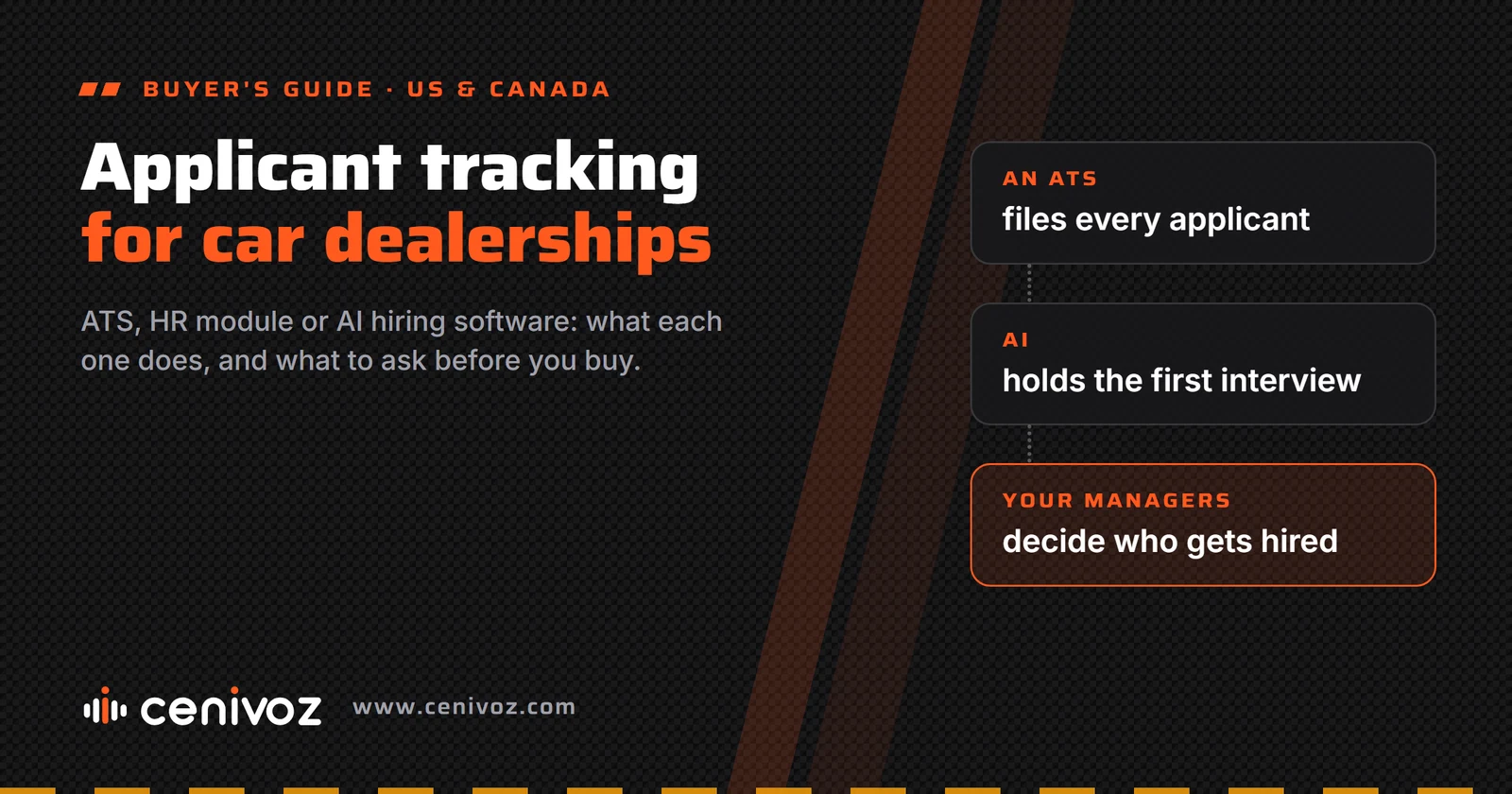
Search for hiring software for a dealership and three different things come back under almost the same words: an applicant tracking system (ATS), the recruiting module inside the HR or payroll software you already pay for, and a newer group of AI hiring tools that screen, schedule or interview applicants for you. They overlap, and vendors use the terms loosely. This guide sorts them out for dealers in the United States and Canada, so you know which one solves the problem you actually have.
What an applicant tracking system does
An ATS is the filing system for hiring. Every application for every job lands in one place, instead of in three managers' inboxes and a stack of paper at the service desk. A good one does six things:
- Collects applicants from every source: your careers page, job boards, referrals and walk-ins.
- Publishes your openings, often to several job boards at once.
- Moves each applicant through stages: new, screened, interviewed, offered, hired or declined.
- Keeps the conversation in one place: emails, texts and notes from everyone involved.
- Keeps the records: who applied, who was interviewed, who decided, and why.
- Reports: how many applied, where they came from, and how long each step took.
That last pair matters more than it sounds. In the US, employers covered by federal anti-discrimination law generally have to keep application and hiring records for at least a year, and a dealer group that can't show how a hiring decision was made has a problem if it's ever questioned.
ATS, HR module or dealership system: three ways to buy one
| What it is | Suits | Watch for | |
|---|---|---|---|
| A recruiting module in your HR or payroll software | An add-on to the system that already runs payroll and onboarding | Stores that hire a few people a year and want one vendor | Often basic: built for HR's paperwork, not for a service manager chasing technicians |
| A general-purpose ATS | A standalone system used by every kind of business | Groups with an HR team that will set it up and keep it tidy | Nothing in it knows what a flat-rate technician or a BDC rep is; you build every job yourself |
| A dealership-focused hiring system | An ATS or hiring tool built around dealership roles and rooftops | Groups hiring technicians, advisors and sales staff all year | Check it still connects to your payroll and HR system, so nobody types a new hire in twice |
There is no wrong answer here. A single store hiring four people a year doesn't need the same thing as a 20-rooftop group with a recruiter. What matters is that applicants stop falling through the cracks.
Where an ATS stops: somebody still has to talk to them
An ATS organizes applicants. It doesn't speak to them. After the software has filed 40 applications for your technician opening, a person still has to read the resumes, call each applicant, leave voicemails, call again, ask the same eight questions, and write down the answers. In most stores that person is a service manager or a general sales manager with a department to run.
That first conversation is where dealership hiring slows down, and it's the part an ATS was never designed to do. Good technicians and salespeople are usually talking to more than one employer, so the store that answers first tends to win. We wrote more about that in speed to interview.
What AI adds, and what to be careful about
"AI hiring software" covers a few different jobs. It helps to ask a vendor which of these theirs does:
- Resume matching. Reads each resume against the job and scores the fit, so the list isn't sorted by who applied last.
- Scheduling. Lets the applicant pick a time themselves, at any hour, with no phone tag.
- Chat or text screening. Asks a few knockout questions in writing.
- AI interviews. Holds the first-round interview itself, by phone or in a browser: asks about experience, asks your must-have questions, follows up on vague answers, then gives your manager a scorecard, the transcript and the recording.
The careful part is the same for all four. AI should gather and summarize, and your managers should decide. Ask how the scoring works, whether every candidate for a role gets the same questions, whether you can read and hear everything the score is based on, and whether candidates are told they are talking to an AI and being recorded. Several US states and Canadian provinces now have rules about exactly these points; our overview of AI hiring rules in the US and Canada covers them.
A checklist for dealerships
Whatever you buy, these are the things that matter in a dealership and get missed in a generic demo:
- Applying from a phone. Most technicians and salespeople apply on one, often after their shift.
- Phone and text, not just email. People who work with their hands don't sit in an inbox.
- Role-specific questions. A technician interview should ask about certifications (ASE in the US, Red Seal or a provincial licence in Canada), tools, and the brands they've worked on. A BDC interview should test how they sound on a call.
- Your own must-ask questions. "Do you have a valid driver's licence?", "Can you work Saturdays?" asked the same way of everyone.
- Rooftops and permissions. Each store sees its own jobs and applicants; group leadership sees all of them.
- Evenings and weekends. Applicants respond when they're off work. The software should too.
- A connection to what you have. An API or a ready-made integration, so your ATS, careers page, payroll and HR system pass data along instead of someone retyping it.
- Your data, your rules. Where it's stored, how you export or delete one applicant's data, and whether it's used to train anyone's AI models.
United States and Canada: what changes
Mostly the product is the same on both sides of the border. A few things aren't:
- Language. In Quebec, job postings have to be available in French, and candidates may expect the process in French. If you hire in Spanish-speaking markets in the US, ask which languages the applicant-facing parts support.
- Privacy. Canada's federal privacy law (PIPEDA) and Quebec's Law 25 put duties on how you collect and use applicant information. In the US the rules vary by state, with California's the broadest.
- AI disclosure. New York City, Illinois and Colorado have rules for automated hiring tools, and Ontario requires larger employers to say in a public job posting when AI is used to screen or assess applicants.
- Recording. Some US states require every party's consent to record a call. Applicants should always be told before an interview starts.
- Time zones. Canada has six, and the 50 US states span six. Booking should always show the applicant's own local time.
This is general information, not legal advice; confirm the details for your stores with your own counsel.
Questions to ask before you sign
- How long until a new applicant hears from us, at 9 PM on a Saturday?
- Who does the first interview, and how long does it take them per applicant?
- Can I see the scorecard, the transcript and the recording behind every recommendation?
- Does it work with the system we already use, and who does the connecting?
- What does a group executive see, and what does a store manager see?
- Where is applicant data stored, and how do I delete one person's data?
- Is there a pilot on real openings before a long contract?
Where Cenivoz fits
Cenivoz is not a job-board poster or a payroll and onboarding system. It does the part an ATS leaves to your managers: the first round. It reads and scores each resume against the job, invites the applicant to interview the moment they apply, interviews them by phone or on the web at an hour they choose, asks your screening questions word for word, and hands your manager a scorecard, a recommendation, the full transcript and the recording. It recommends; your team decides.
You can use it two ways. If you have an ATS, a careers page or a DMS, they send applicants in through our API and get the results back by webhook, so your team keeps working where it works today (how that connection works). If you have none of those, the Cenivoz hiring workspace tracks jobs, applicants, interviews and results on its own, per rooftop, with group executives seeing every store.
It has interview playbooks for 28 dealership roles, including service technicians, service advisors, sales consultants and BDC representatives. Interview data is stored in the United States, and neither your data nor your applicants' is used to train AI models.
The quickest way to judge it is to listen to a sample interview, or book a demo and tell us what you use today.
Common questions
Is an ATS the same as AI hiring software? No. An ATS stores and organizes applicants. AI hiring software does some of the work on them: matching resumes, booking times, or holding the first interview. Many dealers end up with both, connected.
Does a single-rooftop dealership need an ATS? Not always. If you hire a handful of people a year, a tidy process matters more than another system. What you do need is a fast, consistent first conversation with every applicant, and a record of it.
Can AI interviews replace our ATS? They do a different job. If you already have an ATS, keep it and connect the two. If you don't, a hiring workspace that tracks applicants through the first round may be all you need for now.
Will AI decide who we hire? It shouldn't, and with Cenivoz it doesn't. The interviewer gathers the answers and scores them against the job; a person at your dealership reads the result and makes the call.
See every applicant interviewed the day they apply.
Cenivoz interviews your dealership's applicants by phone or web, 24/7, and gives your managers a scorecard, transcript and recording.
